Rising material costs, energy prices and the drive to improve productivity mean UK aluminium processors must do more with less.
Markus Freuis, Managing Director of IMA Schelling UK, explains why the greatest improvements in productivity often come not from a faster machine, but from understanding the role that cutting plays in overall manufacturing performance.
UK aluminium processors are facing pressure from every direction. Manufacturers must deliver greater flexibility, consistent quality and higher productivity while making the best possible use of labour, materials and production capacity. Every investment has to work harder than ever before, and cutting is a critical part of that process.
It’s easy to compare cutting systems by their cutting speed. But productivity is rarely determined by the saw alone. The real value of any investment in cutting lies in the contribution it makes to the wider manufacturing process.
The focus is not only on cutting speed, but also on how the cutting operation reduces handling, shortens idle time and keeps material moving efficiently through subsequent manufacturing stages.
None of this diminishes the importance of optimiSed, Material dependent cutting speed. Quite the opposite. It demonstrates why cutting speed delivers its greatest value when it’s supported by precision engineering, efficient material handling and a well-designed manufacturing process.
Precision cutting remains at the heart of every aluminium processing operation because every downstream stage depends on the accuracy and quality of the cut. Every rejected component, damaged surface or burr requiring secondary finishing consumes additional material, machine time and labour, increasing cost long before a finished part leaves the factory. In today’s market, precision is no longer simply a quality measure; it’s a productivity measure too.
Achieving that level of precision requires different engineering solutions for different applications. Heavy aluminium plate requires machine rigidity and stable material support to maintain accuracy, long profiles depend on controlled handling to prevent deflection, and precision components demand consistently clean, burr-free cutting to minimise finishing operations and protect material.
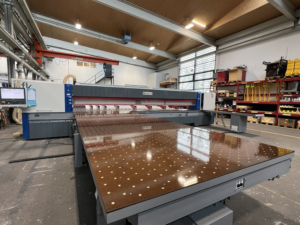
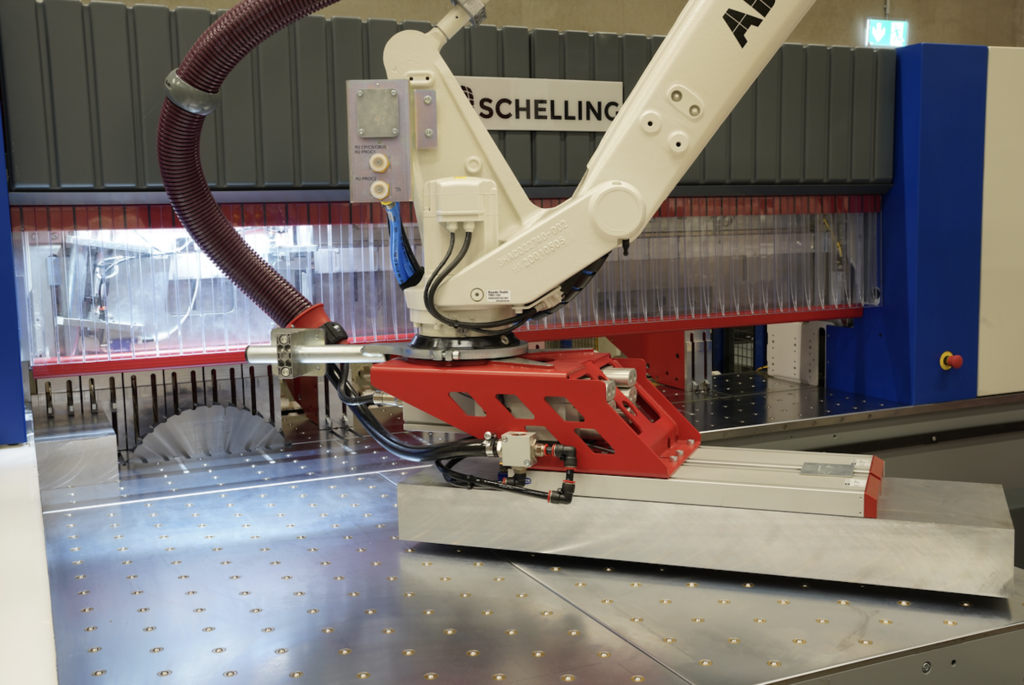
Those application requirements are reflected throughout IMA Schelling UK’s aluminium cut to size portfolio. From precision plate cutting saws for standalone operation to fully automated plate cutting cells and high-volume automation solutions, every system is engineered to maximise productivity across the complete cutting operation. Material feeding, handling, labelling, stacking and offcut removal are designed as part of the system, not as separate processes.
Our cutting systems are engineered to deliver far more than an accurate cut. Robust machine construction and powerful digital drives provide the stability and control needed for repeatable precision in continuous production. One example is the IMA Schelling CLEAN-UP function, which removes up to 99.5% of chips from the working area, helping protect finished surfaces, minimise scratches and burrs, reduce cleaning down times and the need for rework and maximise yield from increasingly valuable material.
For many manufacturers, a standalone cutting system is exactly the right solution. As production volumes increase, plate cutting cells and automated handling can remove manual processes, reduce dead time and increase throughput without compromising precision. The objective remains the same: to achieve the greatest possible return from every investment.
The pressures facing UK aluminium manufacturers are unlikely to ease. As a result, the drive for greater efficiency will remain central to investment decisions and long-term competitiveness. In our experience, the greatest long-term value comes from cutting solutions that strengthen the performance of the entire manufacturing operation.