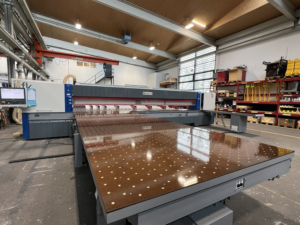
Offcuts aren’t just a disposal job – they’re friction. They take minutes, metres, and money you can’t spare. As volumes grow, leftovers travel: from panel saw → through the workshop → into the corner → out to the yard. The result? More handling, more skips, more lost hours. What feels like a inevitable pile, is a major cost.
Joinery Workshops: How to Reduce the Costs You Can’t Cut
Running a small joinery or furniture workshop means living with variables. Costs and workloads are unpredictable, and staying on top of staffing, customers, production, and cashflow makes staying organised a real challenge for any owner.
Material prices for timber and panel products have risen sharply in recent years. With bespoke work and just-in-time production more in demand than ever, it isn’t only plywood, MDF, and chipboard hitting profits; decorative-faced boards and real-wood veneers are in high demand and typically more volatile and expensive. Smaller shops feel it most – cash flow is tighter and there’s little room to buy in bulk, so price rises go straight to margin.
You can’t control those prices. But you can control how much of what you’ve already paid for becomes finished work – and how much your waste steals in time, space, and disposal fees.
Beyond Board Yield: The Efficiency Left on the Workshop Floor
Most workshops have already squeezed material yield: tighter cutting lists, better sheet use, and, where space allows, a reuse rack for honest offcuts. Waste looks lower on paper. But yield isn’t the only lever – the efficiency opportunity doesn’t stop at the bin. The offcuts that remain are still costing you: in handling, in footprint, and in the way they slow down production.
The real problem isn’t kilograms – it’s geometry. Irregular pieces consume space by shape, not weight. Strips and panels sprawl by volume, often propped against bins that fill too quickly with more air than material and often need re-sorting before they can be moved. As throughput rises, the same scrap percentage means more pieces, more handling, and more interruptions. Space disappears, workflow slows, and wasted minutes add up fast.
The cheapest capacity is the capacity you reclaim.
Workshop space is fixed by machinery, so the losses are physical: where people stand, how far they reach, how often they lift, and whether routes stay straight. Get that wrong and minutes leak away. Offcuts need to be treated as part of the workflow, not just a disposal job.
Offcuts: How Far Does Wood Waste Go?
Waste doesn’t just take up space – it interrupts work and costs time. Every time staff walk around piles, clear a path, or shuffle the same offcut twice, output slows. Let’s say you produce two wheelie bins of offcuts a day. Most won’t fit neatly, so they end up propped against walls or stacked on trolleys. The pile grows through the day and, at close of play, still needs sorting, loading, and dragging to the skip. That’s 20–30 minutes gone every day, just moving leftovers. Add the lifting, re-sorting, and dozens of trips from saw to bin, and waste handling quickly eats into productive hours.
Every cut creates a walk. Dozens of small trips add up to weeks per year.
Deal with timber and panel offcuts where they first appear – at the panel saw, the mitre station, or that bench that always collects odds and ends – so they don’t keep moving.
Wood and Panel Offcuts: Changing the Shape for the Future
Change how offcuts move and sit, and you turn lost minutes into output without adding headcount, hours, or square metres. Productivity follows efficiency; start with what you can actually change.
That’s why many workshops now shred offcuts as part of their production process. Shredding changes waste from awkward geometry into uniform chips, and bins fill with material rather than air. You get less waste building up, routes stay clear, and disposal or recycling is simpler.
For a small to medium shop producing under 3 m³ of offcuts a week, a compact shredder such as the UNTHA LR520 turns bulky waste into 12–30 mm chips. Coarser screens maximise volume reduction and suit disposal or biomass heaters; finer chips provide the consistency needed for briquetting.
The result is easier handling, lower disposal costs, and a ready stream of reusable material – with further options like warm-air heating systems or briquette production, either for your own use where suitable, or as a potential revenue stream.
When Wood Waste Starts Wasting Profits
Disposal costs add up fast. Skips are still the go-to solution, but they can put a real dent in the balance sheet.
Under a typical trade contract, a small joinery shop producing around 3 m³ of offcuts a week will usually fill a 6-yard skip every fortnight, costing in the region of £6,000–£7,000 a year in collections. Shredding can reduce waste volume by around 70%, so the same skip might only need swapping every six weeks. That brings the annual bill down to roughly £2,000–£2,500 – a saving of more than £4,000 a year, before you even count reclaimed labour time.
Mixed Wood Waste: From Challenge to Opportunity
Many smaller businesses sell solid timber or sheet offcuts or burn them to save money, but it’s hard to scale when work gets busy and volumes rise. And it doesn’t solve the problem of disposing of mixed waste that includes MDF.
Shredding helps either way: it reduces volume across all offcuts. Clean waste, such as chipboard, OSB, plywood, timber, and some laminated chipboards, can be recycled, while mixed loads that include MDF, melamine, or foil-backed boards typically go to biomass. Using a shredder turns waste into a uniform, usable form, so instead of being a compliance risk or a time drain, it becomes simpler to handle, cheaper to collect, and ready for recycling or energy recovery.
The Hidden Value of Wood Waste
Sustainability is becoming increasingly important – not only as a personal value for woodworking businesses, but also as a decision factor for customers who want suppliers that demonstrate environmental responsibility. And that includes what happens to waste.
For a small workshop, shredding provides a tangible proof point: every piece of material has its maximum potential squeezed out. Instead of a mismatched pile, a risky burn, or unnecessary collections, your waste becomes part of the circular system. By making waste part of your sustainability commitment, you show values that matter increasingly to clients and partners.
The Best Compact Shredder for Small Workshops
A shredder isn’t just a benefit for large-scale production. Whether you’re a small joinery workshop producing kitchens or interiors, or a high-volume manufacturer of furniture, doors, or commercial fit outs, reducing waste doesn’t stop with board yield. Reducing the waste already created frees up time, space, and labour that’s better spent on production.
And that’s exactly where the UNTHA LR520 comes in. Taking up less than 1 m² of floorspace, the compact wood shredder is built for small workshops, slotting in right where offcuts are produced. It’s a one-person job: offcuts go straight in, chips come straight out. Instead of filling and emptying bins by hand, shredded chips can be pulled away by your existing dust extraction into the same bags or containers that already collect your sawdust and shavings.
Like any investment to improve efficiency in your workshop, the bigger picture matters. There’s no point saving time on waste if you lose it to maintenance or energy costs. That’s why the LR520 features a gravity-fed design that draws waste straight in. The result? No hydraulic pusher to maintain – just fewer moving parts, less servicing, and, with its energy-efficient 11 kW motor and automatic shut-off, one of the most efficient and low-maintenance shredders in its class.
For smaller workshops, it’s about working smarter – turning offcuts from a cost into an opportunity, and waste handling into part of efficient production, not a distraction from it.