Most workshops can price a bespoke part to the penny: materials, machining time, overheads and margin. The time lost getting parts through production is harder to pin down – and it can quietly eat into the return.
The ability to make exactly what each job calls for wins orders. Delivering it on time and to the standard promised is what brings customers back and builds a workshop’s reputation. And when production is already under pressure, there’s rarely a plan B – every avoidable delay leaves less room to put something right.
For shopfitters and fit-out specialists, building to the space has always been the job. For joinery workshops making kitchens, fitted and freestanding furniture, made to measure is increasingly the norm, with customers expecting their own sizes, materials and finishes. Either way, the cutting list changes with every job: carcasses in non-standard widths and heights, panels scribed to fit walls and staircases, and fillers shaped to accommodate walls that are out of true.
As workshops adapt to that demand and take on more bespoke and batch-size-one work, the mix of components moving through production becomes more varied. That can mean more setups and handling, often with costly boards – veneered MDF, laminate-faced panels and lacquered boards – where a recut isn’t cheap. A few minutes here, a board change there, a part waiting for the next machine – none seems much on its own, but across a busy order book the effect on margin, and on capacity for the next job, can be larger than expected.
The Silent Cost of Bespoke Parts
Time lost between operations affects any business making bespoke parts, from fit-out specialists, where almost every part is made to measure, to large production lines that offer made-to-measure options alongside their standard range. It’s usually accepted as part of how long the job takes. Much of it doesn’t have to be.
Take one example: a bespoke order with non-standard parts, dropped into the middle of a standard run. The time shows up in familiar places.
The saw comes off the run for new setups. The parts go off to be drilled and grooved, each with its own program – or a jig that may never be used again. They wait for the edgebander to come free, go through, and one comes back for the hole that got missed. Meanwhile, the standard parts behind them are waiting too.
Non-standard parts tend to need an experienced operator – someone who can set up, program and check a part they’ve never made before without cutting it twice. So some of the most expensive hours in the building go on a handful of parts.
Then there’s the offcut: one odd shape out of a full board, leaving a piece that goes on the rack with all the others that are nearly the right size for something.
“You can have a full order book and still feel like you’re chasing the day,” says Daniel Limb, Operations & Sales Manager at IMA Schelling UK, who spent years in manufacturing management before joining the company. “When I was managing production, it was never one big thing – it was the little interruptions, and none of them showed up on the job sheet. Get enough of them and it’s the team that feels it.”
A Quick Sum for Bespoke Parts
You’ll know your own numbers better than anyone. But put even fifteen minutes of extra setup and handling on each bespoke part, run ten through a day, and that’s two and a half hours, a third of a skilled shift, that may never have made it into the price.
Panel Saw, Nesting or Combined Cell?
Most shops handle bespoke parts in one of three ways, and you’ll know the trade-offs. Cutting on the saw and drilling and grooving elsewhere gives flexibility, at the price of a second setup and a move for every part. Nesting is strong on yield and flat parts, but brings a spoilboard to maintain and parts to separate and edge elsewhere.
In a workshop set up machine by machine, every order is a mix of parts that need different things – cut to different sizes, then some drilled, some grooved, some edged – and many of them make that round trip on their own. Which option fits depends on the work going through your workshop now, where the time is being lost, and the work you want to take on. If it’s the round trip that’s costing you, the next step is to cut out the move – which is what a combined cell is built to do.
Keeping Bespoke Parts in One Cell
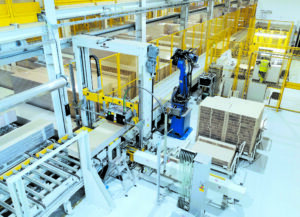
Every move can mean more handling, another setup, and another chance for a costly part to get marked, chipped or set up a fraction out. A combined cell such as IMA Schelling’s BIMA CUT brings cutting and machining into one place. Run by a single operator, it cuts, drills and grooves a part from a standard board without the part leaving the cell. An optional edge gluing unit lets it edge the part there too.
Because every part is programmed in advance, either in design software or at the machine, the cell does whatever that part needs – drilled, grooved, edged or simply cut – and moves on to the next without being set up again.
What that saves depends on how you work now. For parts that would otherwise go from the saw to a separate machine, it can remove a setup and a transfer. Parts are held on vacuum blocks rather than a spoilboard, so there’s no sacrificial board to maintain, and with five sides accessible, more of the machining can happen in one place. Offcuts are removed automatically, so nobody’s picking them up and carrying them off to the waste. And when it’s paired with an edge processing machine, one operator can supply panels to the BIMA CUT and feed parts to the edgebander.
The BIMA CUT is built for made-to-size cabinets, sloping-ceiling units, curved and angled work, decorative panels and fillers.
Panel Saw and CNC in One: Matching the Machine to the Mix
In workshops where variety is the mainstay and most parts need drilling and grooving as well as cutting, the cell can take on much of that work.
Alongside a main line, it does a different job. For a larger manufacturer running batch-size-one work next to volume production, a separate cell gives varied components their own route without sending every one through the main line. And because the BIMA CUT can be integrated into a larger manufacturing system, the cell can still form part of the wider production flow.
Remakes get a route outside the main run, too. A damaged or mis-machined part can be cut again individually, without another setup on the volume line.
What it isn’t aimed at is straight volume cutting of standard parts. That’s the job beam saws and panel dividing lines are built for.
Follow a Bespoke Job Through the Workshop
Pick the next bespoke job that comes in and follow it from the first board to the last finished part. Count the setups, moves and waits, then see how often they repeat across a day. When you look at how the workshop runs, the question isn’t just whether a machine can make the part. It’s how many of those steps it takes out, and how much skilled time that gives back. Put a number on the avoidable ones, and you’ll find out how much time you’ve been giving away.
Find an hour of skilled operator time each day the workshop runs, and that’s around 250 hours back a year – more than six weeks of a full-time operator. What is that time worth to your workshop?
IMA Schelling UK works with furniture and joinery businesses on every stage of the route a part takes – panel storage, cutting, drilling, CNC machining, edge banding and handling – from standalone machines to fully integrated production, with support from our Wetherby team and technicians across the UK and Ireland.